Reasons vary as to why people decide to enroll their children in cyber schools.
For some, it's to avoid disciplinary and behavior problems they feel are rampant in the brick-and-mortar school. Others feel their child is not thriving in public school and choose cyber school instead of charter, private or parochial options.
Regardless of the reason, almost 30,000 students in Pennsylvania are being served by cyber schools, according to the Commonwealth Foundation. Cyber schools remain controversial, though, in terms of real student success, costs and the money they drain from public schools.
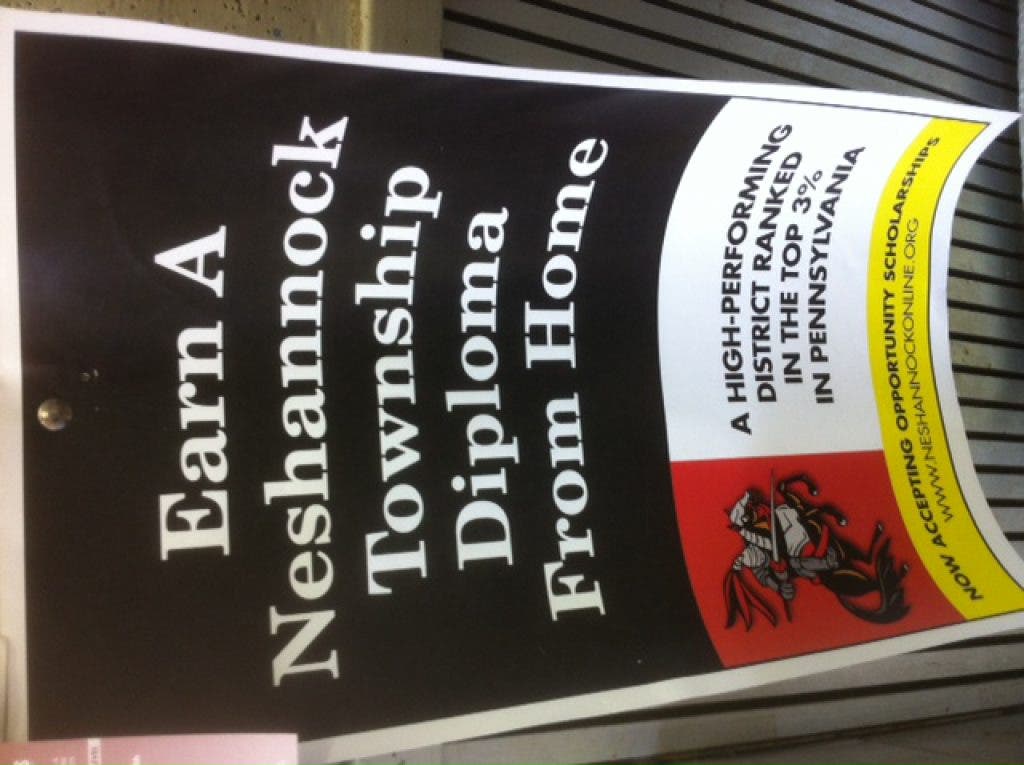
Neshannock Township School District, located just north of New Castle, seems to have come up with a way to keep that money in-house while still providing students residing in the district with an online learning option.
According to a video on the district website, Neshannock School District Online Learning Academy for grades K-12 is an "extention of district's educational offerings." Students who enroll and live in Neshannock can get support services and use district resources because they are close to home. The cyber students stay on track with instruction at the school and can participate in the district's extracurricular activities.
They even have live tutors available from 2 p.m. to 1 a.m. At the end, they also get a Neshannock diploma. But best of all for Pittsburgh area residents, they accept the state's opportunity scholarship money available to students in "failing" districts.
Posters for the online learning academy have made their way as far south as the . One has been hanging in the Kuhn's Market bulletin board in Wilkins Township for more than a week.
Woodland Hills School Board member earlier this year and said that since the 2005-06 school year, her district has shelled out more than $47 million for charter and cyber charter schools, but been reimbursed only $7.5 million of that. The 2011-12 school year cost Woodland Hills $12 million with $0 reimbursement, Reis said.
A district-run online academy might keep some of that money at home for Woodland Hills and other districts in western Pennsylvania. It would also allow students to feel more a part of the district in which they live.
Gateway School District in Monroeville already has the Gateway Cyber Academy for grades 9-12. Seneca Valley also instituted its own cyber school.
So, do you see a district-run online academy as a way for your school district to keep from losing money as the next generation increasingly turns to cyberspace vs. classrooms?
Take our poll and let us know why in the comments section.
Key word - Public.
“But thanks for playing,” punctuated with a “LOL” no less! You’re truly the literary wit of your generation! I can’t wait to see what gems you bring out next. Perhaps a “See ya, wouldn’t want to be ya!” Or maybe a “don’t let the door hit you on the way out!” I can only imagine that Mark Twain, George Orwell, Thomas More and the great Dr. Martin Luther King, Jr. can now rest easy with the knowledge you have taken up their mantle. Reading your post, it’s painfully obvious that you still don’t get it. That’s OK though, you’re just a kid. Perhaps when puberty sets in, your body goes through those awkward changes and you mature a little, you’ll get it. Until then, you and EC should be content with the kids table at Thanksgiving and let mommy and daddy have grown up time.
(from Patch article of recent months) http://baldwin-whitehall.patch.com/articles/photos-best-brightest-honored-at-bhs-senior-awards-ceremony#photo-10128370
I believe this comes from cc's continuing insistence that every poster who disagrees with cc, is all ml, so far cc has said this about 8 or 9 different posters. You're probably next, EdM. If so, welcome to the imaginary world of cc.
Let's get back to the good old days.
There is no picture of you so clear as the one you paint here of yourself. May God soothe your tortured soul.
I just signed off on the one who took it off topic to rant and YELL, from here on in, s/he gets only prayers. I'd like to see each district have a cyber school program, for those students who are unable to behave in class and who disrupt the learning of others, as well as for those students whose learning style meshes best with computerized instruction. Let the districts keep their funding while adding another layer of individualizing instruction for our students. One size does not fit all in education.
The same cost per student in a Brick or Mortar School should be no more than 8K on what you are saying, but the school district keeps 20% of the money from the alloted amount. Baldwin is getting over 10,000 per student a year and when they have to send the money to a charter or cyber school for a student they are only sending a little over 8,000. Why shouldn't the full amount be sent with the student. That 2,000 that they are getting should be returned to the state if a child doesn't make use of joining sports or activities at the local school, but the School Districts keep the money. If I had a children today in school, I would be opting to send my children to where the ratio of student/teacher is 9 students to 1 in a cyber/charter school than then 25-30/1 ratio in a Brick or Mortar School. I would expect students on this ratio getting a much better education than at your Brick or Mortar School.
believe the linked and cited facts or believe the opinion above.
May God soothe your tortured soul.
starting with cc 1:39 pm on Monday, September 10, 2012 cc 2:43 pm on Friday, September 28, 2012 cc 5:52 pm on Saturday, September 29, 2012 and even inserts her snarky comments using my name on articles I had not even read let alone commented on yet. She ran one poster off the PATCH and is apparently trying to do the same to others. But I see your point, and will just continue to pray for some peace for her, for whatever compels her to continue like this. As I said to Cindy: I'd like to see each district have a cyber school program, for those students who are unable to behave in class and who disrupt the learning of others, as well as for those students whose learning style meshes best with computerized instruction. Let the districts keep their funding while adding another layer of individualizing instruction for our students. One size does not fit all in education.
A report on 14 schools in those two counties shows that they are giving up from $6,828 to $11,000 for each of their students enrolled in cyber charter schools, an amount determined by the school's average cost per student. That amount increases to as much as $25,000 for special education students, according to the report. The tuition for a student living in one Pennsylvania district who is enrolled in a public cyber charter school might be... (continued)
And Pennsylvania school districts are paying a tuition rate to send a student to a cyber charter school that is often much higher than the actual cost to educate the student. The superintendents at schools that have started their own cyber schools to keep their students in house say the average cost of educating those students is around $4,200. The report suggests that the state require the districts to pay the lowest per-student cost rate in the region for each student attending other schools [the $6,828 paid by Panther Valley] OR...
The arguments: Districts shouldn't be paying different rates for the same service and cyber schools operate at a "fraction" of brick and mortar schools. As reported in an earlier PATCH article, any bill to reform financing of charter/ cyber charter schools should address4 key areas: 1. Limiting unassigned fund balances for charter/cyber charter schools consistent with limits already in effect for traditional public schools. 2010, auditor general reported charter schools had $108 million reserve funds. Nearly 1/2 of charter schools had reserve fund balance above public schools' limit of 12 %of annual spending. Charter balances were as high as 95 % (continued)
•Limiting special education funding that a charter school receives per student to its school district's total per-pupil spending for sped services. The state funding formula's 16-percent cap on school district sped population does not apply to charter schools. •Requiring year-end audits by Department of Education to determine actual costs of education services of charter schools, an annual year-end final reconciliation of tuition payments from school districts against actual costs , overpayments to be returned to the school districts.